Fifteen Google Play Rejections and Not One Straight Answer
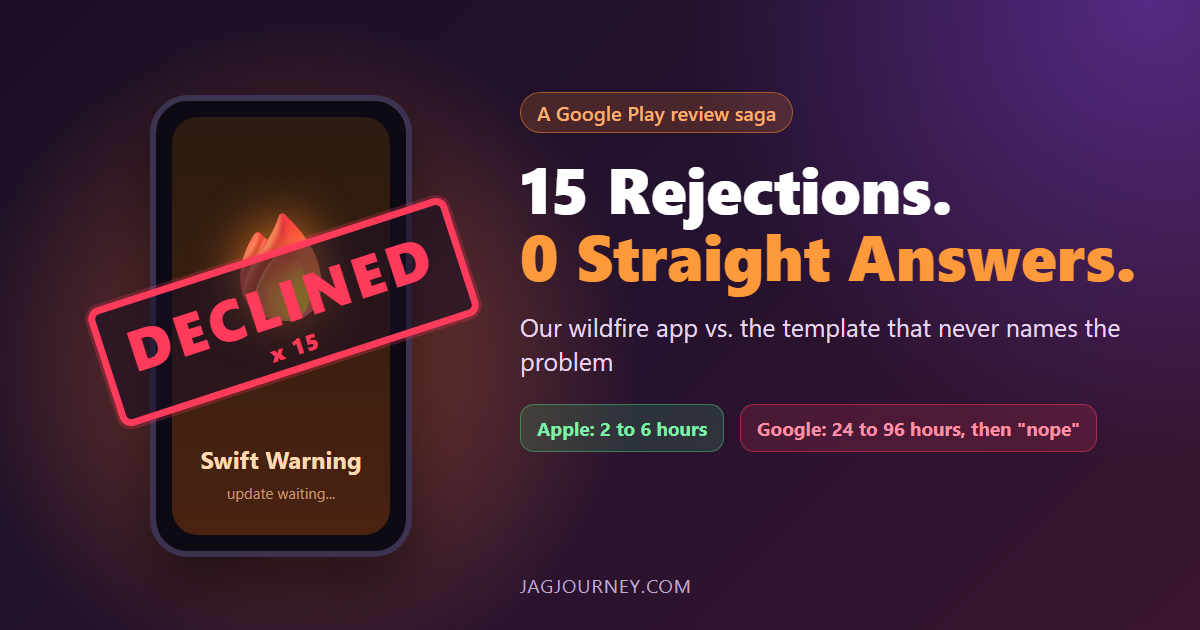
Some companies collect stamps. Some collect vintage guitars. Since August 17, we have been collecting Google Play rejection notices for our wildfire and hazard awareness app, Swift Warning. We are now up to fifteen. If Google handed out a frequent rejector punch card, we would have earned a free sandwich, a commemorative mug and possibly a small parade.
We are telling this story with a smile, because at this point it is either laugh or cry, and we used up our crying budget back in September. But under the jokes there is a serious point. A safety app is stuck in a loop, and the loop will not give us the one thing we need to get out: a straight answer.
The short version #
The app: Swift Warning, a wildfire and hazard awareness app from Jag Journey, LLC.
The score: 15 Google Play policy notices since August 17, 2026. Only 2 of them named the link or source they objected to.
The race: when we submit the same update to both stores at the same time, Apple typically approves it in 2 to 6 hours. Google Play typically takes 24 to 96 hours, then declines it, then takes another 24 to 96 hours on the next try.
The cost: finished, tested safety improvements wait on the shelf while we play "guess the link."
The ask: tell us which link, which source, which line. We will fix it the same day.
The great app review race #
Every time we ship an update to Swift Warning, we send the same build to Apple and Google at the same moment. Same features. Same fixes. Same disclaimers. Same government sources. It is the closest thing the app world has to a science experiment.
Here is how the race usually goes.
Apple: We press submit, refill our coffee, answer two emails, and somewhere between 2 and 6 hours later, Apple says "approved." The coffee is still warm. Sometimes it is still too hot to drink.
Google: We press submit. We wait a day. We wait another day. We check the console so often that the refresh button files a complaint. Somewhere between 24 and 96 hours later, Google says "declined." Then we fix whatever we can guess at, submit again, and wait another 24 to 96 hours to find out whether the guess was right.
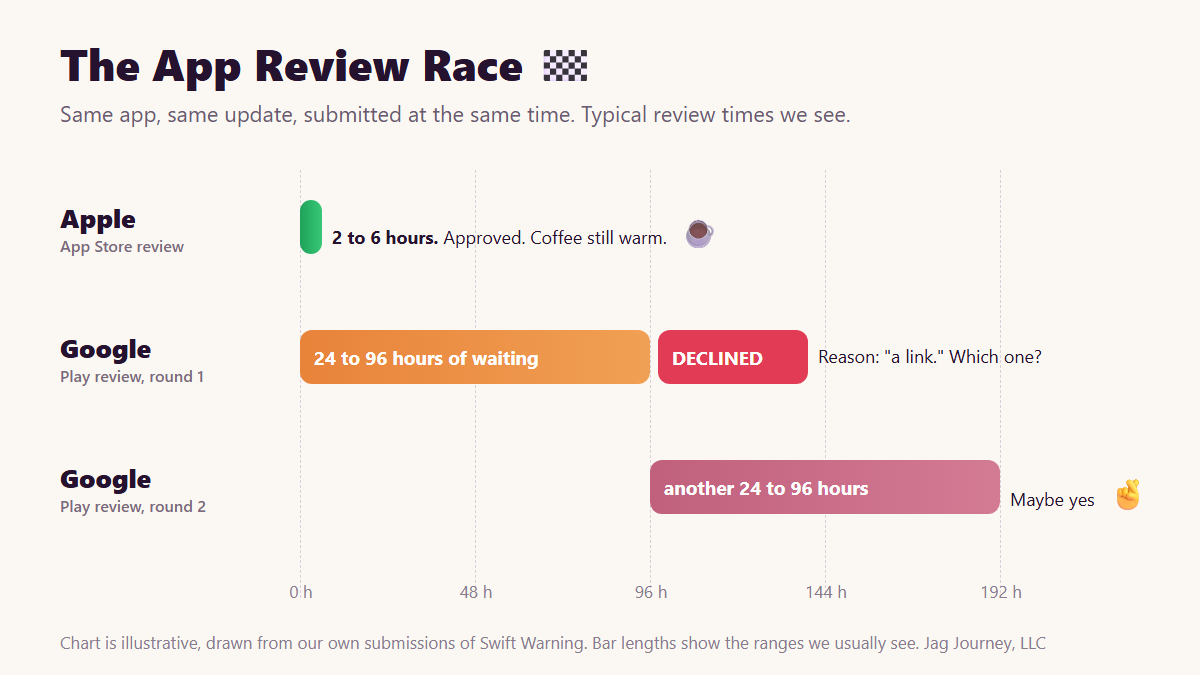 The same update, submitted to both stores at the same time. One of these lines is a lot shorter.
In the time it takes Google to say "no" once, Apple could, in theory, approve our app about fifteen times. We have not tested that. We are not trying to get on anyone's watch list.
To be fair to everyone involved: these are the review times we see on our own submissions. Review times can change with volume, season and the phase of the moon. But when one store reviews the same build in an afternoon and the other takes most of a week, and then asks us to try again, it gets hard not to notice.
The rules, as written #
Let us look at what Google actually publishes, because we have read these pages more times than most people read their own lease.
Google's requirements for apps that share government information ask for two things. First, list your government sources clearly in the store description so people can check them. Second, make it clear that your app is not a government agency. Google even gives examples, like a .gov address for United States agencies and a .go.jp address for agencies in Japan.
Google's misleading claims policy says you cannot pretend to be a government agency, offer government services you are not allowed to offer, or stick the word "Official" on your app without permission.
And Google's own enforcement process page says that when it takes action, it will send "relevant information about the action we've taken." It also says developers must fix every problem before they resubmit.
That is the whole rulebook. We printed it out. It fits on the fridge, right next to the takeout menu.
What Swift Warning does #
Swift Warning lists the government agencies whose public information it shows, and each one links to that agency's official website. There are United States .gov sites, the Japan Meteorological Agency on jma.go.jp (yes, the exact example from Google's own page), Environment Canada, the Norwegian national weather service and the European Commission's Copernicus program.
Right above that list, in plain words, the description says Swift Warning is not a government agency, does not represent one, is not endorsed by one and is not an official warning or evacuation service. The app says the same thing inside. The title is just "Swift Warning." No "Official." No fake badges. No tiny pretend uniforms.
We are about as far from "pretending to be the government" as a company can get. We do not even own a lanyard.
Fifteen notices: the highlight reel #
Imagine a teacher who hands back your essay with "Wrong" written on top. You ask what is wrong. The teacher hands it back again with "Still wrong." You rewrite the whole thing. "Wrong." You add footnotes. "Too many footnotes." That is roughly how the last two months have felt.
August 17: A notice named one broken link. We fixed it the same day. This is how it is supposed to work. We felt like heroes. We may have high-fived.
September 1, 6, 8 and 9: Four notices that said "Insufficient Sources Provided." None of them named a source. So we added more. Then more. We went from 11 sources to 26 government sources plus several others.
September 14: Another "Insufficient Sources" notice. So we added even more. That same day, a different Google check blocked our listing because it was so packed with sources that it no longer described the app well. One part of Google asked for more sources. Another part said we had too many. It was a friendly game of tug of war, and we were the rope.
September 24 and 26: "Broken link" notices that named nothing. Our own tests found that some official government websites block automated visitors, and one government site was not loading for anyone at all. We moved every one of them to a page from the same agency that opens.
September 28: A notice finally named a page. That page opened fine for us, both as a normal visitor and as Google's own crawler. We moved it anyway, because we are agreeable people.
October 1: An appeal reply used a website as its example that was not even in our description at the time. We removed that data from the app the next day anyway. We are very agreeable people.
October 16, 18 and 19: Three more notices. One quoted our entire description back to us, like a book report, and named nothing. Every link opened.
October 19: For the first time, a support ticket showed us exactly what Google was comparing against. We acted on it within a day.
October 20: Google approved and published our update. Confetti. Cake. We called our families.
October 21: Support asked us to add links for six non-government data providers we mentioned. No published rule asks for that, but we were happy to do it.
October 24: The update with those new links was declined for a "broken link." Which link? You guessed it. Not named. Every link opened for us as Google's crawler, as Google's phone crawler and in a normal browser. We removed every non-government link anyway, and the update is back in review. Cue another 24 to 96 hours.
Final tally: fifteen notices. Two of them named a link. Thirteen of them sent us on a scavenger hunt with no map, no clues and no prize at the end.
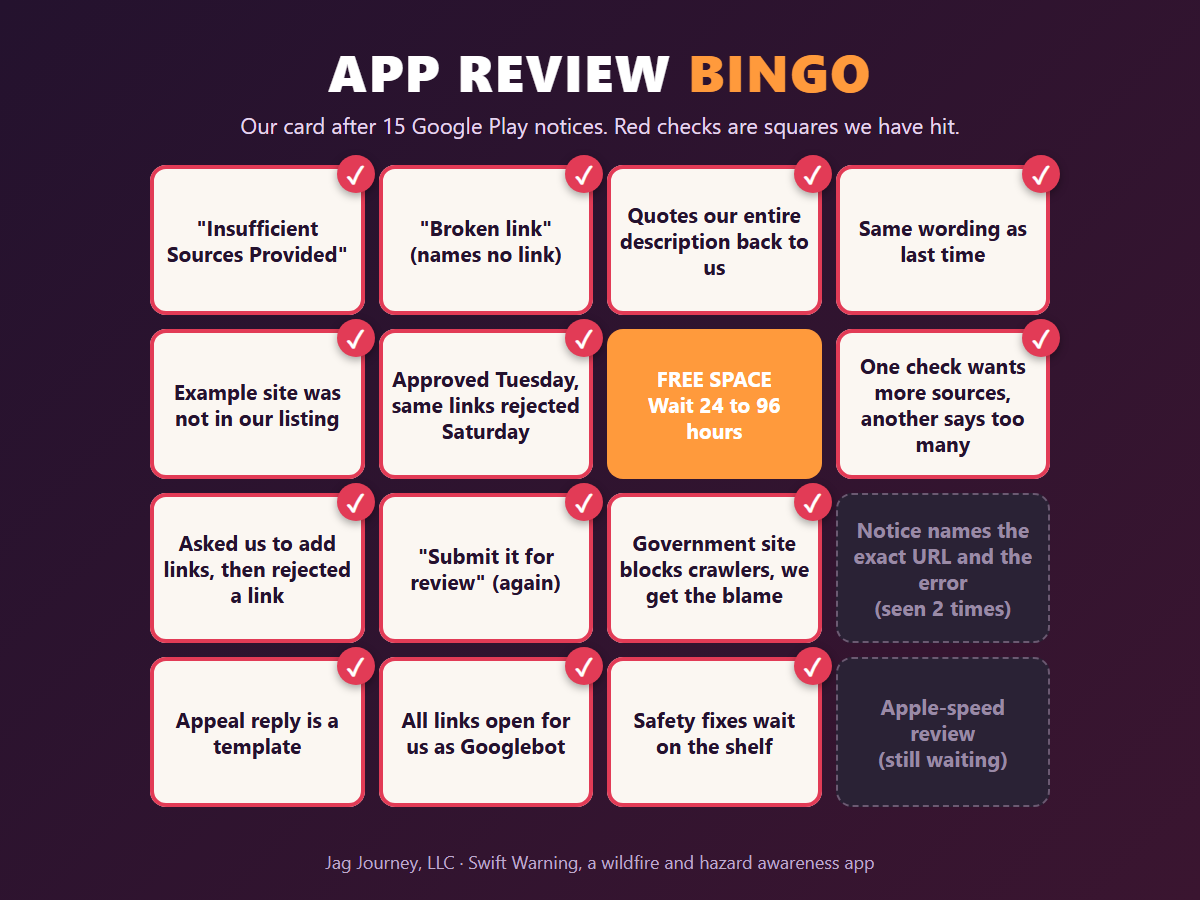 Our bingo card. The only squares we have not hit are the ones we actually want.
The plot twists #
The same government links that Google approved on Tuesday, October 20 were part of a rejection on Saturday, October 24. Nothing about them changed. Same links, same agencies, same pages. If a link can be fine on a Tuesday and broken on a Saturday without anyone touching it, that is either a magic trick or a very moody internet, and we have questions for both.
Then there is the part where Google asked us to add links, we added them, and we were declined for having a link Google would not name. We followed the instructions and got a penalty. It is like being told to bring a dish to the potluck and then being asked to leave because of the casserole.
And when an official government website blocks automated crawlers, Google's included, that is not something we control. Neither does Google's policy. But somehow the app is the one sitting in the penalty box.
What this is costing, and not just us #
Here is where we stop joking for a minute.
Swift Warning is a wildfire and hazard awareness app. Fire season does not wait for an app review, and neither do the storms, floods and quakes that come in between. Every time an update is declined, the work inside it waits too. That includes safety improvements and fixes that are finished and tested, and new protections we would like to put in people's hands. Our iPhone users already have them, usually the same afternoon we submit. Our Android users are still waiting on the next round of "guess the link."
We are a small company. When we spend a week rewriting a store description for the ninth time, that is a week we did not spend making the app better at the thing it exists to do. Multiply that across two months and you start to see why we are writing a blog post instead of release notes.
We are not asking for special treatment. We are not asking Google to bend a single rule. We are asking for the rules to be applied the way they are written, the same way each time, with the one detail every developer needs: which link, which source, which line.
Specific answers work. We have receipts. #
This might be the most hopeful part of the whole story. Every single time Google told us something specific, we fixed it within a day or two. The one time we got clear evidence we could fully act on, Google approved the app.
That is not a complaint. That is a recipe. The system works great when it uses its words.
What we have asked Google for #
We sent a detailed appeal with the full timeline and links to Google's own policy pages. In short, we asked for:
The exact address that failed, with the date, time and error. We will fix it the same day.
The exact policy text the decision relies on.
If no link actually fails, approval of the update that is now in review.
A senior reviewer who reads the whole history, not just the latest template.
A look at the process that sends notices without naming the problem, so the next developer does not have to write a blog post like this one.
Frequently asked questions #
Why does Google Play keep rejecting Swift Warning? #
The notices cite Google's misleading claims policy, either for "Insufficient Sources Provided" or for a "Broken or Inaccessible Source Link." Thirteen of the fifteen notices did not say which source or link was the problem, so we have not been able to confirm the exact reason.
Is Swift Warning a government app? #
No. Swift Warning is independently operated by Jag Journey, LLC. It is not a government agency, is not affiliated with or endorsed by one, and is not an official warning or evacuation service. It links to the official government sources whose public information it shows.
How long does app review take on Apple compared to Google Play? #
For our own submissions of Swift Warning, Apple typically approves an update in 2 to 6 hours. Google Play typically takes 24 to 96 hours to review the same update, and a declined update needs another 24 to 96 hours on the next submission.
Is Swift Warning still available on Android? #
Yes. The current version stays available on Google Play while the newer update is in review, so existing users keep getting alerts. They just have to wait longer for the newest improvements.
To be clear #
We like Google Play. Millions of people find helpful apps there, including ours. We believe most reviewers are doing their best with a giant pile of apps and not enough hours in the day. Automated checks miss things, and templates save time. We get it.
But a notice that says "a link is broken" and then quotes 25 links back at us is not a fix. It is a riddle. And riddles are fun at parties, not in safety software.
So, Google, if you are reading this: we are ready. Our coffee is hot. Our editor is open. Tell us the link, and we will have it fixed before the coffee gets cold. Apple has proven that is possible.
Until then, Swift Warning keeps working for the people who already have it, and we will keep you posted right here. And if you are a developer stuck in the same loop, take heart. You are not alone. There are at least two of us, and one of us has a sandwich card.
With good humor and a lot of patience,
Jag Journey, LLC
Jag Journey, LLC
The team behind Swift Warning, VoVo and the rest of the Jag Journey family of apps.
Related Posts
Should Your Business Use an AI Chatbot for Customer Questions?
An AI chatbot can answer routine questions at midnight, or confidently give a customer the wrong refund policy. Here is how to decide if one fits your business and how to set it up responsibly.
How to Back Up the Photos and Files on Your Phone
Your phone holds years of photos, messages and notes. Learn the difference between photo syncing and phone backups, how to keep a second copy, and what to check before you switch or lose a phone.
How to Make Sure Emergency Alerts Reach Your Phone
Wireless emergency alerts can save precious minutes, but only if your phone is set up to receive them. Here is how to check your settings, sign up for local alerts and build reliable backups.
A Tech-Ready Family Emergency Plan: Contacts, Power and Copies
When disaster strikes, phones become flashlights, maps, radios and lifelines. Here is how to prepare your family's devices, contacts, documents and power so technology helps instead of failing.
The 3-2-1 Backup Rule Explained With a Small Office Plan
The 3-2-1 rule is the simplest reliable backup strategy: three copies, two kinds of storage, one offsite. Here is what it means and a practical plan a small office or household can set up this week.
Comments (0)
No comments yet. Be the first to share your thoughts!