How to Apologize Well, Without Excuses

Everyone hurts people they love. We snap at our kids, forget a promise, say something careless to a friend or let a coworker down. What matters most is often not the mistake itself but what we do next.
A sincere apology can repair trust, soften hurt and even bring people closer. A weak apology can make things worse, leaving the other person feeling dismissed or blamed. This post explains how to apologize well.
Why apologies go wrong
Many apologies fall flat for predictable reasons:
- They are vague. "Sorry about earlier" does not show you understand what happened.
- They shift blame. The apology quietly turns the focus back to the other person.
- They come with excuses. Explaining why you did it can sound like justifying it.
- They rush forgiveness. Expecting an immediate "It's fine" puts pressure on the hurt person.
- Nothing changes. Repeating the same behavior turns future apologies into empty words.
The good news is that each of these is fixable.
Phrases that weaken an apology
Watch for these common phrases:
- "I'm sorry if you were hurt." The word "if" suggests the hurt might not be real.
- "I'm sorry, but..." Anything after "but" tends to erase what came before.
- "I'm sorry you feel that way." This apologizes for their feelings rather than your actions.
- "Mistakes were made." This avoids saying who made them.
- "You made me so angry that..." This places responsibility on them.
Try replacing them with direct ownership: "I'm sorry I raised my voice at you."
Five parts of a sincere apology
A strong apology usually includes these parts. You do not need to follow a rigid formula, but covering each one helps.
- Name what you did. Be specific. "I'm sorry I made a joke about your cooking in front of everyone."
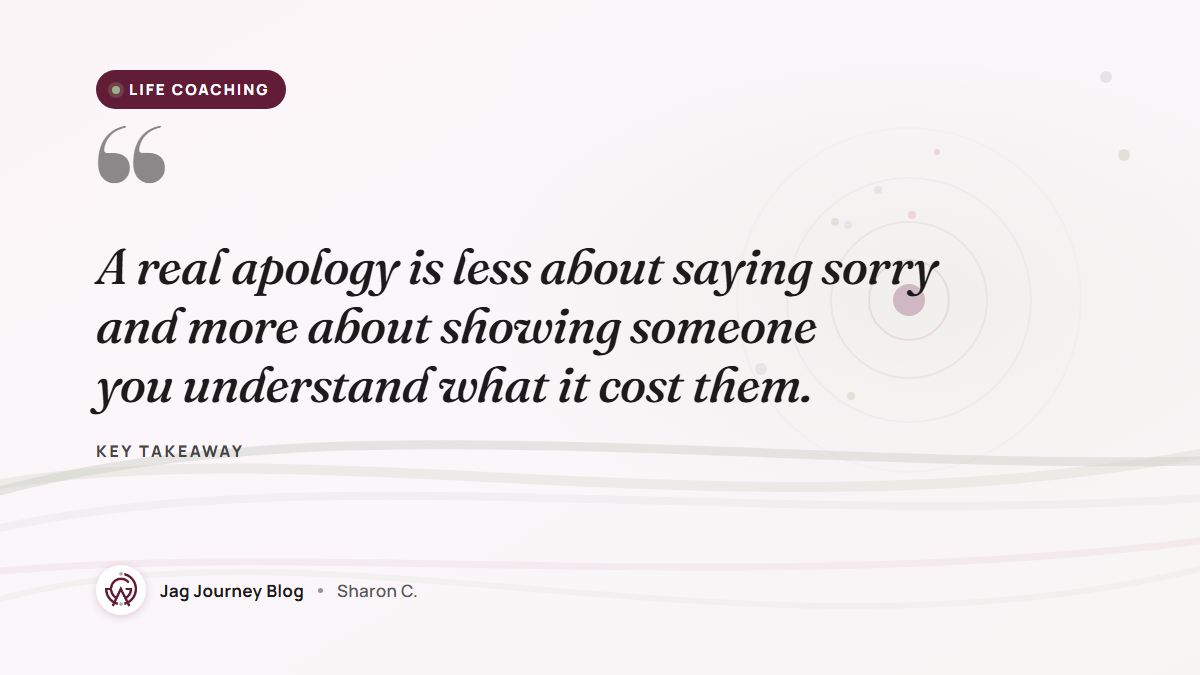
- Acknowledge the impact. Show you understand how it affected them. "That was embarrassing, and it was unkind."
- Take responsibility. No excuses or blame. "That was my choice, and it was wrong."
- Offer to make it right. Ask what would help, or suggest a step. "Would it help if I told the group I was out of line?"
- Commit to change. Name what you will do differently. "I'm going to stop making jokes at your expense."
Then stop talking and listen. The other person may want to share how they felt. Let them, without defending yourself.
Write your apology first
If you owe someone an apology and feel nervous, try writing it first. This exercise takes about fifteen minutes.
- Write what happened in one or two factual sentences.
- Write how it likely affected them. Imagine their experience.
- Draft your apology using the five parts above.
- Read it out loud. Remove any "if," "but" or explanation that sounds like an excuse.
- Decide how to deliver it. In person is usually best for significant hurts, but a call or handwritten note can also work.
Writing it first helps you stay focused and sincere when emotions rise.
Making amends
Sometimes words are not enough. If your actions caused a real loss, such as a broken item, missed work or damaged reputation, think about how you can repair it. Replace what was broken. Correct a false impression. Give back the time you took.
Jesus taught that reconciling with someone you have wronged is important enough to interrupt even an act of worship (Matthew 5:23-24). Making things right is part of a life of faith.
When they are not ready to forgive
A sincere apology does not guarantee immediate forgiveness. The other person may need time, especially if the hurt was deep or part of a pattern. Pressuring them to forgive quickly can undo the good of your apology.
Instead, say something like, "I understand if you need time. I'm here when you're ready." Then show through consistent change that your apology was real. Trust is rebuilt through actions over time.
Apologizing to children
Parents sometimes hesitate to apologize to their kids, worried it will weaken their authority. In reality, a sincere apology teaches children how to take responsibility and repair relationships. "I'm sorry I yelled at you. I was frustrated, but that wasn't okay. Next time I'll take a breath before I talk" is a powerful lesson.
If your apology leads into a deeper conversation, How to Prepare for a Hard Conversation can help. And if you are on the other side, needing to forgive someone, read How to Forgive Someone Who Hurt You Without Excusing the Harm.
Frequently asked questions
What makes an apology sincere?
A sincere apology names what you did, acknowledges how it affected the other person, takes full responsibility without excuses, offers to make it right and commits to change.
Should I explain why I did it when I apologize?
Usually not at first. Explanations can sound like excuses. If the other person asks why, you can share briefly after you have taken responsibility.
What if I apologize and they do not accept it?
Respect their need for time. Let them know you are open to talking when they are ready, and focus on showing change through your actions.
Related Posts

How to Find and Work With an Accountability Partner
The right accountability partner can help you follow through on goals that matter. Learn who to ask, what to agree on and how to run check-ins that actually help.

Why Asking for Help Is So Hard and How to Start
Many capable people would rather struggle alone than ask for help. Learn what makes asking so hard and how to make one small, specific request this week.

Coaching Questions That Help a Friend Think It Through
When a friend brings you a problem, the most helpful response is often a good question, not advice. Learn coaching questions that help people find their own answers.

How to Forgive Someone Who Hurt You Without Excusing the Harm
Forgiveness is not the same as excusing harm, forgetting or instantly trusting again. Learn what forgiveness is, what it is not and a gentle unsent letter exercise to begin.

Co-Parenting Communication That Keeps Kids Out of the Middle
Co-parenting after separation is hard, but children do better when adults communicate calmly. Learn a business-like approach, written channels and a simple message template.
Comments (0)
No comments yet. Be the first to share your thoughts!