How to Prepare for a Hard Conversation
Some conversations we put off for weeks. Telling a friend she hurt you. Asking your spouse to change how money is handled. Letting an employee know their work is not meeting expectations. Talking with an aging parent about whether it is safe for them to keep driving.
Hard conversations rarely go perfectly, but they go much better with preparation. A little time spent thinking ahead can help you stay calm, say what matters and listen well. This post gives you a simple planner you can fill out in about twenty minutes.
Why preparation helps
When we walk into a hard conversation unprepared, emotions tend to drive. We say too much or too little. We bring up every past grievance. We get defensive when the other person responds. Afterward, we replay what we wish we had said.
Preparation does not script the conversation. It helps you get clear on what you want, what you know and what you will ask, so you can stay grounded even when feelings run high.
The conversation planner
Grab a notebook and work through these seven parts. Write short answers. You are clarifying your thinking, not writing an essay.
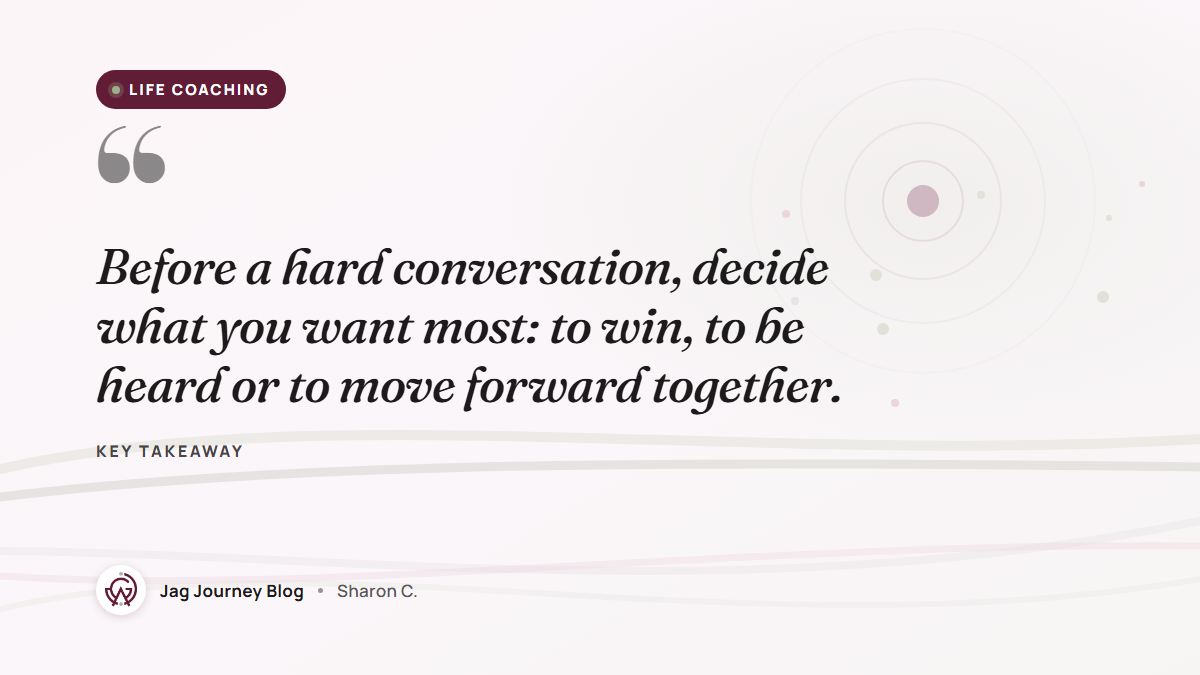
- My purpose. What do I most want from this conversation? Be honest. To be understood? To change a specific behavior? To repair the relationship? To make a decision together? If your purpose is to win or to make the other person feel bad, pause and reconsider.
- The facts. What happened, as a camera would have recorded it? Leave out interpretations. "You arrived 40 minutes late to the last three dinners" is a fact. "You don't respect my time" is an interpretation.
- My feelings. How did this affect me? Use "I" words. "I felt embarrassed in front of our guests." "I felt worried."
- Their possible view. How might they see this? What pressures, fears or reasons might they have? You may not know, but imagining helps you approach with curiosity.
- My part. Is there anything I contributed, even something small? Owning your part often softens the conversation.
- My request. What specific thing am I asking for? "Would you text me if you're running more than ten minutes late?" is much clearer than "I need you to be more considerate."
- Timing and place. When and where will we both be calm, rested and free from interruptions? Avoid late nights, rushed mornings and public places for sensitive topics.
When you finish, read your planner once more. Cross out anything that sounds like an accusation. Keep the facts, feelings and request.
Opening lines that lower defenses
The first thirty seconds often set the tone. Try opening with care and clarity:
- "I value our friendship, and there's something I'd like to talk through. Is now a good time?"
- "I want to talk about something that's been on my mind. My goal is for us to work through it together."
- "I've noticed something and I'd like to understand your side."
An old proverb captures why tone matters so much: "A soft answer turneth away wrath: but grievous words stir up anger." (Proverbs 15:1, KJV). A gentle start does not weaken your point. It makes it more likely to be heard.
During the conversation
A few reminders while you talk:
- Share facts, then feelings, then your request. Keep it brief.
- Listen fully. Let them respond without interrupting. Then reflect back what you heard before replying. Listening to Understand explains how.
- Stay on one topic. If other issues come up, say "That's worth talking about too. Can we come back to it another time?"
- Take a break if needed. "I'd like a few minutes to think. Can we pick this up in an hour?"
- Look for agreement. Even a small shared step is progress.
If it goes badly
Sometimes, despite good preparation, a conversation goes poorly. The other person gets angry, shuts down or denies everything. That does not mean you failed. You spoke honestly and kindly, which is your part.
Give it time. Many people need a day or two to process before they can respond well. You might follow up later: "I know our talk was hard. I'm still open to working this out whenever you're ready."
When not to have the conversation alone
Some conversations need extra support. If there has been abuse, threats, violence or a pattern of intimidation, a one-on-one conversation may not be safe. Talk with a licensed counselor first, and involve a mediator, a pastor or another trusted person as appropriate. In any situation where you feel in danger, prioritize your safety and call 911 in an emergency.
If the conversation involves a boundary, What a Healthy Boundary Is (and What It Is Not) can help you frame it. For more relationship tools, browse our life coaching collection.
Frequently asked questions
How do I start a difficult conversation?
Choose a calm time, open with care for the relationship and ask whether now is a good moment. Then briefly share the facts, how they affected you and one clear request.
What if I get emotional during a hard conversation?
That is human. Pause, take a breath and say you need a moment. You can also ask to continue later. Having your planner notes nearby can help you stay grounded.
Should I write out exactly what I want to say?
Write your key points, especially the facts and your request, but avoid a word-for-word script. Notes help you stay focused, while a script can make it hard to listen and respond naturally.
Related Posts
Co-Parenting Communication That Keeps Kids Out of the Middle
Co-parenting after separation is hard, but children do better when adults communicate calmly. Learn a business-like approach, written channels and a simple message template.
Giving Honest Feedback People Can Actually Hear
Feedback is easier to hear when it is specific, timely and kind. Learn a simple observation, impact and request pattern you can use at work, at home and in volunteer settings.

Why Asking for Help Is So Hard and How to Start
Many capable people would rather struggle alone than ask for help. Learn what makes asking so hard and how to make one small, specific request this week.
How to Apologize Well, Without Excuses
A good apology can repair trust, but a weak one can make things worse. Learn the parts of a sincere apology, the phrases to avoid and how to follow through afterward.

Too Many Goals? How to Choose the One That Matters Now
A long list of goals can leave you busy but stuck. This simple triage helps you weigh each goal by impact, timing, energy and season, then choose one focus to start with.
Comments (0)
No comments yet. Be the first to share your thoughts!