What a Healthy Boundary Is (and What It Is Not)
"Boundaries" has become a popular word, and like many popular words it gets used in confusing ways. Some people hear it and think of cold, distant people who cut everyone off. Others use it as a polite way to make demands. Neither is what a healthy boundary really is.
This post gives you a plain working definition, clears up the most common misunderstandings and walks you through writing your first boundary statement.
A working definition
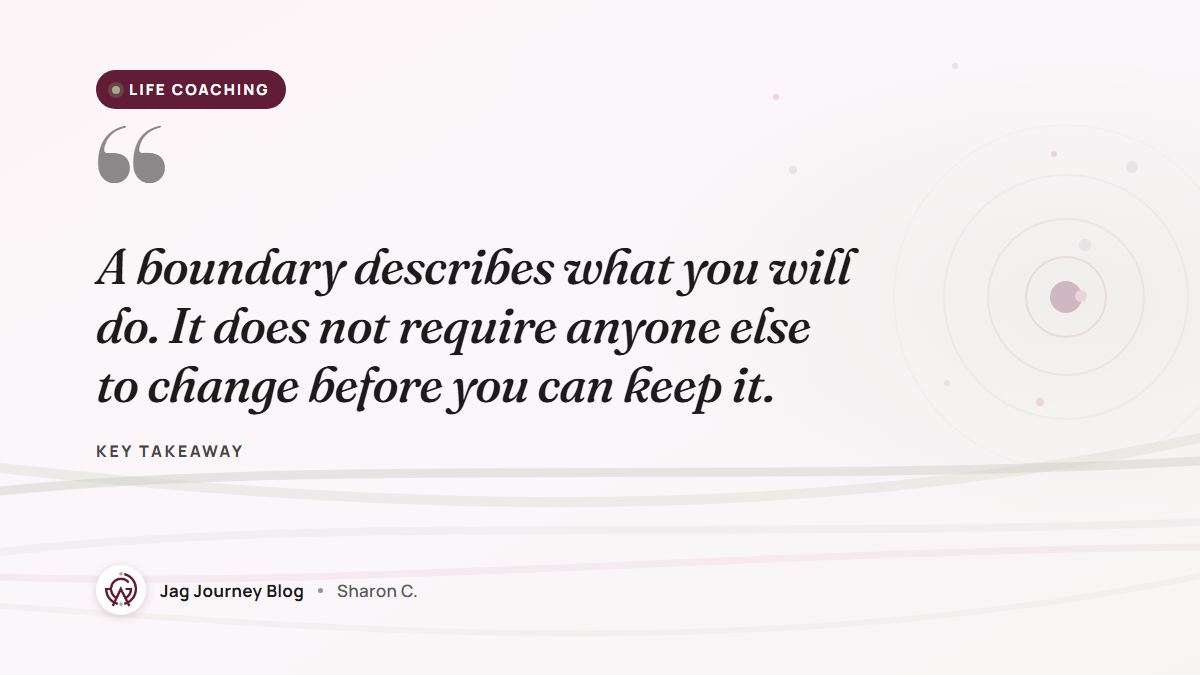
A healthy boundary is a decision about what you will and will not do, communicated clearly when it affects others. It protects something you value, such as your time, your health, your family, your faith or your peace.
The heart of that definition is the word "you." A boundary is about your own choices. You cannot control another person's behavior, but you can decide how you will respond to it.
Compare these two statements:
- "You need to stop calling me during work."
- "I don't answer personal calls during work hours. I'll call you back after five."
The first is a request, which is perfectly fine to make, but its success depends on the other person. The second is a boundary. You can keep it whether or not anyone agrees.
What a boundary is not
It is not a wall. A wall keeps everyone out. A boundary is more like a fence with a gate. It defines where your responsibility starts and stops, and you decide who comes through and when.
It is not a punishment. If the real goal is to make someone feel bad, it is not a boundary. Healthy boundaries are calm and steady, not angry or vengeful.
It is not a way to control others. "If you go out with those friends, I'll leave" may sound like a boundary, but if its purpose is to force another adult's choices, it is closer to an ultimatum.
It is not a one-time speech. Most boundaries are kept through repeated, quiet action, not one big conversation.
It is not unloving. Even Jesus stepped away from crowds who wanted more from Him. Luke 5:16 notes that He often withdrew to lonely places to pray. Rest and limits were part of a life of love, not opposed to it.
Everyday examples
Boundaries show up in ordinary places. Here are a few:
- A coworker messages you late at night: "I check messages between 8 and 5. I'll reply in the morning."
- A relative gives unrequested parenting advice: "We've decided how we're handling bedtime. Let's talk about something else."
- A friend often cancels at the last minute: "I won't plan ahead with you for a while, but I'm happy to get together when you're free that day."
- You keep saying yes to volunteering: "I'm serving one Sunday a month this season, and I'm not adding more."
Notice what these have in common. Each one is short. Each one is about the speaker's own action. None of them requires the other person to agree.
Write your first boundary statement
Here is a simple exercise you can do in about ten minutes.
- Name a situation that drains you. Think of a recurring moment that leaves you resentful, exhausted or anxious. Be specific: "My sister calls every night at dinner and talks for an hour."
- Name what it threatens. What value or need is being crowded out? Family dinner time, rest, focus or peace?
- Decide what you will do. Focus only on your own action. "I will let calls during dinner go to voicemail and call back after 7:30."
- Write it as an if-then statement. "If my sister calls during dinner, then I will let it go to voicemail and call her back after 7:30."
- Decide whether to communicate it. Some boundaries need a kind heads-up. "I want to give my kids my full attention at dinner, so I'll start calling you back afterward." Others you simply keep.
Keep your statement somewhere visible for the first few weeks. Boundaries feel awkward at first. That is normal, and it usually fades with practice.
When boundaries are about safety
Some situations call for more than a well-worded boundary. If someone is threatening, controlling, hitting or frightening you, your safety comes first. Please reach out to a domestic violence hotline, a licensed counselor or local authorities, and in an emergency call 911. Boundaries are a tool for ordinary relationships. They are not a substitute for protection from abuse.
For more practical help with relationships and limits, explore our life coaching articles, including the tools in Name Your Core Values in Five Steps, since your values tell you what your boundaries are protecting.
Frequently asked questions
Is setting boundaries selfish?
No. A healthy boundary protects your ability to love and serve others well over time. Exhausted, resentful people have less to give, and limits help keep your care honest and sustainable.
What if someone gets upset when I set a boundary?
Their feelings are real, and you can acknowledge them kindly without giving up the boundary. Discomfort is common when a pattern changes, and it often eases as people adjust.
Do I have to explain my boundaries?
Not always. A short, kind explanation can help in close relationships, but you do not owe anyone a long justification. Clear and brief is usually best.
Related Posts

Why Asking for Help Is So Hard and How to Start
Many capable people would rather struggle alone than ask for help. Learn what makes asking so hard and how to make one small, specific request this week.

Boundaries for Generous People Who Serve at Church
Serving at church is a gift, but saying yes to every need can lead to exhaustion. Learn how to check your capacity, serve in seasons and talk honestly with church leaders.
Setting Boundaries With Family Members You Love
Family boundaries can feel the hardest to set because love and history are involved. Learn how to choose one boundary, plan the conversation and hold it with kindness.
Family Screen Rhythms Without Constant Battles
Screen time arguments can wear everyone out. Learn how to create a family screen agreement together, model healthy habits as adults and set rhythms instead of endless rules.

How to Find and Work With an Accountability Partner
The right accountability partner can help you follow through on goals that matter. Learn who to ask, what to agree on and how to run check-ins that actually help.
Comments (0)
No comments yet. Be the first to share your thoughts!