Boundaries for Generous People Who Serve at Church

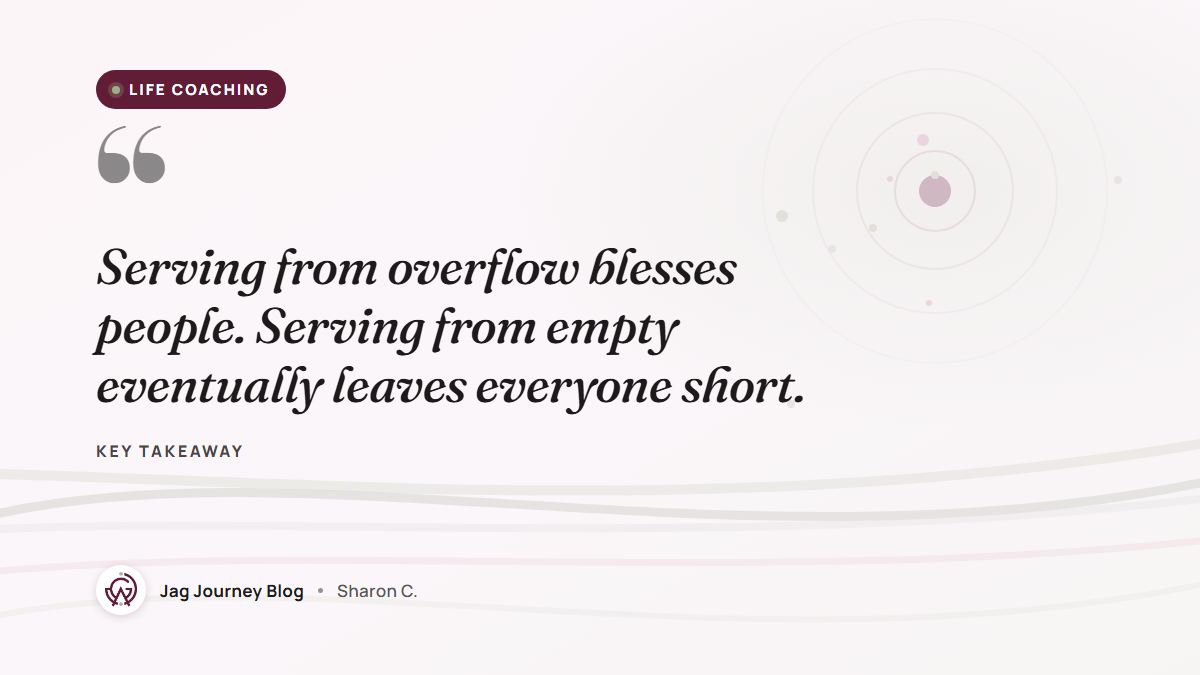
Every church has them. The people who teach Sunday school, run the coffee bar, help with the youth retreat, organize meals for new moms, sing on the worship team and still somehow show up early to set up chairs. They are generous, faithful and often very tired.
If you are one of those people, thank you. Your service matters. This post is not about serving less for its own sake. It is about serving in a way you can sustain, so your generosity lasts for years instead of burning out in a few seasons.
When generosity turns into exhaustion
Serving at church carries a special kind of pressure. The needs are real. The work feels connected to God. Saying no can feel like letting down your church family or even God Himself.
So generous people keep saying yes. Over time, a ministry role that once brought joy starts to feel heavy. Family time shrinks. Personal time with God gets squeezed out by time doing things for God. Resentment creeps in, often with guilt about feeling resentful.
None of this means you are less spiritual. It means you are human, with a finite amount of time and energy.
Signs you may be overcommitted
Watch for these warning signs:
- You dread Sundays or ministry meetings that used to energize you.
- Your family regularly feels like they get your leftovers.
- You have not been fed spiritually in a while because you are always serving.
- You say yes before checking your calendar.
- You feel irritated with people you are serving.
- You are the only one who knows how to do several things.
- Rest feels impossible because something always needs to be done.
If you nodded at several of these, it may be time to reassess.
Moses had limits too
In Exodus 18, Moses was judging disputes for the people of Israel from morning until evening. His father-in-law Jethro watched and said something every overcommitted servant needs to hear: "Thou wilt surely wear away, both thou, and this people that is with thee: for this thing is too heavy for thee; thou art not able to perform it thyself alone." (Exodus 18:18, KJV).
Jethro's advice was to share the work with capable people. Moses listened, and the result was better for everyone. Limits were not a failure of faith. They were wisdom.
Jesus also invited His tired disciples to "come ye yourselves apart into a desert place, and rest a while" (Mark 6:31, KJV). Rest was part of ministry, not a break from it.
The capacity check
Set aside thirty minutes for this exercise. It works best done prayerfully.
- List every commitment. Write every ministry role, recurring task and regular responsibility at church. Include the small ones.
- Estimate the time. Next to each, note roughly how many hours a month it takes, including preparation, meetings and travel.
- Rate the energy. Mark each one as life-giving, neutral or draining.
- Note your gifts. Put a star next to roles that use your natural gifts well.
- Look at the total. Compare the monthly hours with what your family, work and health can actually support right now.
- Choose. Decide which roles to keep, which to reduce and which to hand off at a natural stopping point.
Most people find that their starred, life-giving roles are where they bless others most. Draining roles that do not fit your gifts may be a better fit for someone else.
Serve in seasons
Serving does not have to look the same all the time. Life has seasons: a new baby, caring for a parent, a demanding job, recovery after illness. Some seasons allow for more service and some for less. It is okay to serve heavily in one season and lightly in another.
Thinking in seasons also makes it easier to step back without guilt. "I'm stepping back from the nursery this year while my mom needs more care" is honest and reasonable.
Talking with church leaders
Many volunteers avoid this conversation because they fear disappointing their pastor or ministry leader. Most leaders would much rather hear about your capacity early than lose you to burnout later.
A simple way to start:
"I love serving here, and I want to keep serving well. Right now I'm stretched too thin. I'd like to finish my commitment to the fall retreat, then step back from the hospitality team. I'm happy to help train someone to take my place."
Notice that this gives a clear plan, a timeline and an offer to help with the transition. That makes it easier for everyone.
Stepping back with grace
When you step back, do it well:
- Finish current commitments when possible.
- Give as much notice as you can.
- Share what you know so the next person can succeed.
- Keep showing up as a member, receiving as well as giving.
Stepping back from one role can make room for someone else to discover their gifts. It can also make room for you to rest, grow and later serve again with fresh joy.
For more on limits in general, read What a Healthy Boundary Is (and What It Is Not), and if your sense of worth is wrapped up in how much you do, Your Worth Is Not Measured by Your Output is a helpful next step. You can also explore more faith resources on our Faith and Purpose page.
Frequently asked questions
Is it wrong for a Christian to say no to serving at church?
No. Scripture shows that even Moses needed to share the load, and Jesus invited His disciples to rest. Saying no to one role can help you serve faithfully where you are most needed and gifted.
How do I tell my pastor I need to step back?
Be honest and specific. Explain that you want to keep serving well, give a timeline, offer to help with the transition and thank them for the opportunity.
How many ministry roles should one person have?
There is no fixed number. It depends on your season, family, work and health. A capacity check that compares monthly hours with what your life can support is more helpful than a set rule.
Related Posts

Setting Boundaries With Family Members You Love
Family boundaries can feel the hardest to set because love and history are involved. Learn how to choose one boundary, plan the conversation and hold it with kindness.

Discover Your Gifts by Asking the People Around You
Others often see your strengths more clearly than you do. Learn how to ask five people what they see in you, look for patterns in their answers and put your gifts to work.

How to Find and Work With an Accountability Partner
The right accountability partner can help you follow through on goals that matter. Learn who to ask, what to agree on and how to run check-ins that actually help.

Why Asking for Help Is So Hard and How to Start
Many capable people would rather struggle alone than ask for help. Learn what makes asking so hard and how to make one small, specific request this week.

Coach, Counselor or Therapist: Which Kind of Help Do You Need?
Coaching, counseling and therapy can all help, but they are not the same. Learn what each one does, when licensed care should come first and how to choose wisely.
Comments (0)
No comments yet. Be the first to share your thoughts!