How to Fact-Check AI-Written Content Before You Publish It
AI writing tools can produce a polished first draft in seconds. That speed is real and useful. But the draft can contain a statistic nobody ever measured, a quote nobody ever said, a link to a page that does not exist or a confident claim that was true years ago and is not now.
These mistakes are not rare glitches. They come from how the tools work: they generate text that sounds plausible rather than looking up verified facts, unless they are connected to sources, and even then they can misread them. Our plain-language explainer on how AI chatbots work goes deeper.
Here is a practical review process for anything AI helped you write, from a blog post to a donor letter.
Before you start: decide what level of review fits
A casual internal brainstorm needs a light touch. Anything published under your organization's name, sent to customers, or touching health, money, law or safety needs a full review, and sometimes an expert. Set that expectation in your team's AI use policy so nobody has to guess.
Pass 1: Mark every factual claim
Read the draft once with a highlighter, real or digital. Mark every statement that could be true or false: facts about the world, descriptions of how something works, claims about your own products or services, and anything presented as common knowledge.
You may be surprised how many there are. Each one needs a source you trust, or it needs to change.
Pass 2: Verify numbers and dates
Statistics, percentages, prices, dates and version numbers are where AI drafts most often go wrong.
- Trace each number to its original source, not a blog that repeats it.
- Check that the source actually says what the draft claims, for the same place and time period.
- If you cannot find a reliable source, remove the number or replace it with a general statement.
- Be especially careful with "studies show" and "research found" language. If you cannot name the study, cut the claim.
Pass 3: Check quotes and attributions
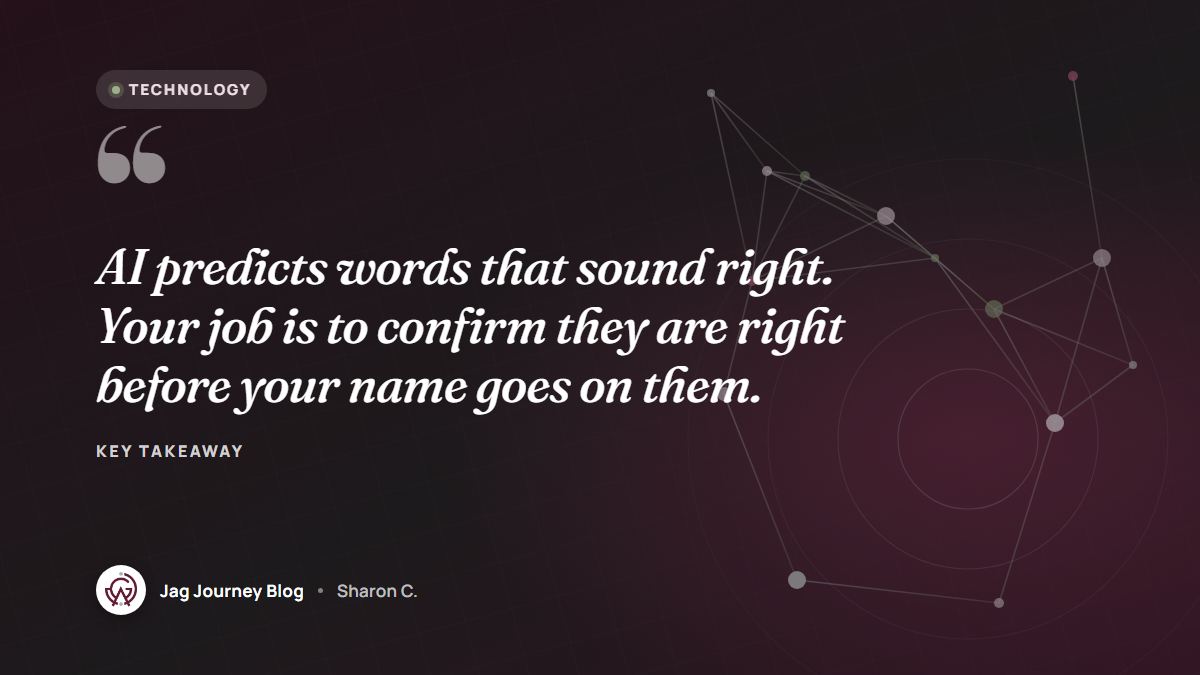
Never publish a quote from a real person without confirming they said it. AI tools can invent realistic quotes and attach them to real names. Search for the exact wording, and find it in a primary source such as the person's own writing, an official transcript or a reputable publication. If it cannot be confirmed, remove it.
The same goes for testimonials and stories. Do not publish AI-written customer stories, reviews or testimonials as if they were real.
Pass 4: Click every link and check every citation
- Open each link and confirm the page exists.
- Confirm the page says what the draft claims it says.
- Prefer primary sources, such as official documentation or government pages, over secondhand summaries.
- Remove citations to books, papers or articles you cannot locate.
Pass 5: Review the metadata, not just the body
Titles, meta descriptions, image alt text and structured data often get less attention than the article, yet they appear in search results and are read by assistive technology. Google's guidance on using generative AI content specifically calls out checking these elements for accuracy.
- Does the title describe what the page actually delivers, without exaggeration?
- Does the meta description match the content?
- Does each image's alt text describe the image honestly?
- If the page has structured data, such as FAQ markup, does it match the visible text exactly?
Pass 6: Make it yours
Accuracy is necessary but not sufficient. Read the draft again and ask whether it reflects what you actually know and believe.
- Add your own experience, examples and judgment where they help the reader.
- Remove generic filler and repeated points.
- Adjust the voice so it sounds like your organization.
- Ask whether a reader would find this useful if they arrived directly, not through a search engine.
Search engines have been clear that using AI is not the problem; publishing large amounts of unhelpful content made mainly to rank is. A careful human edit is what turns a generic draft into something worth reading.
Keep a simple claims list
For important pieces, keep a short list alongside the draft: each key claim, the source that supports it and the date you checked. It takes a few minutes and makes later updates much easier, because you know exactly what to recheck.
Frequently asked questions
Can I ask the AI to check its own work?
You can ask it to flag claims that need verification, which is a helpful starting list. But it can confidently confirm its own mistakes, so the actual checking must be done against reliable sources.
Do I need to disclose that AI helped write something?
It depends on the context, your audience's expectations and any rules that apply to you. Many organizations disclose when AI content could be mistaken for human experience, such as images or customer conversations. Set a consistent approach in your team policy.
What if a fact cannot be verified?
Remove it or rewrite it as clearly labeled opinion or general guidance. A shorter, accurate piece is always better than a longer one with an unsupported claim.
Related Posts

How to Write an AI Use Policy for a Small Team
Your team is probably already using AI tools. A short, clear policy helps them do it well: which tools are approved, what information stays out, when a human must review, and when to disclose.
Writing Better AI Prompts: A Practical Method for Busy People
Vague prompts get vague answers. This simple method, with before-and-after examples, helps you give AI tools the context, task, format and limits they need to produce something useful.

Should Your Business Use an AI Chatbot for Customer Questions?
An AI chatbot can answer routine questions at midnight, or confidently give a customer the wrong refund policy. Here is how to decide if one fits your business and how to set it up responsibly.
Using an AI Coding Assistant Wisely When You Are New to Code
AI coding assistants can explain errors, suggest code and even run tasks for you. Here is how beginners can use them as tutors rather than crutches, and the safety habits that matter from day one.
Using AI-Generated Images in Your Business: Rights, Disclosure and Quality
AI image tools can produce a blog header or social graphic in seconds. Before you use one commercially, understand the ownership questions, the rules of the tool, and the checks that keep you honest.
Comments (0)
No comments yet. Be the first to share your thoughts!