What the Parable of the Talents Teaches Small Business Owners
Few passages are quoted in Christian business circles as often as the parable of the talents in Matthew 25. It is sometimes used to argue that God wants every believer to multiply money. That reading misses much of what Jesus was saying. Read carefully, the parable is less about returns and more about trust, fear and faithfulness.
It still has a lot to teach anyone who runs a business. This post walks through the story, draws out several lessons, and ends with a practical exercise you can do this week.
The story in brief
A man preparing for a long journey calls his servants and entrusts his property to them. One receives five talents, another two, and another one, "to every man according to his several ability" (Matthew 25:15, KJV). A talent was not a skill in the original story. It was a very large sum of money, many years of a laborer's wages.
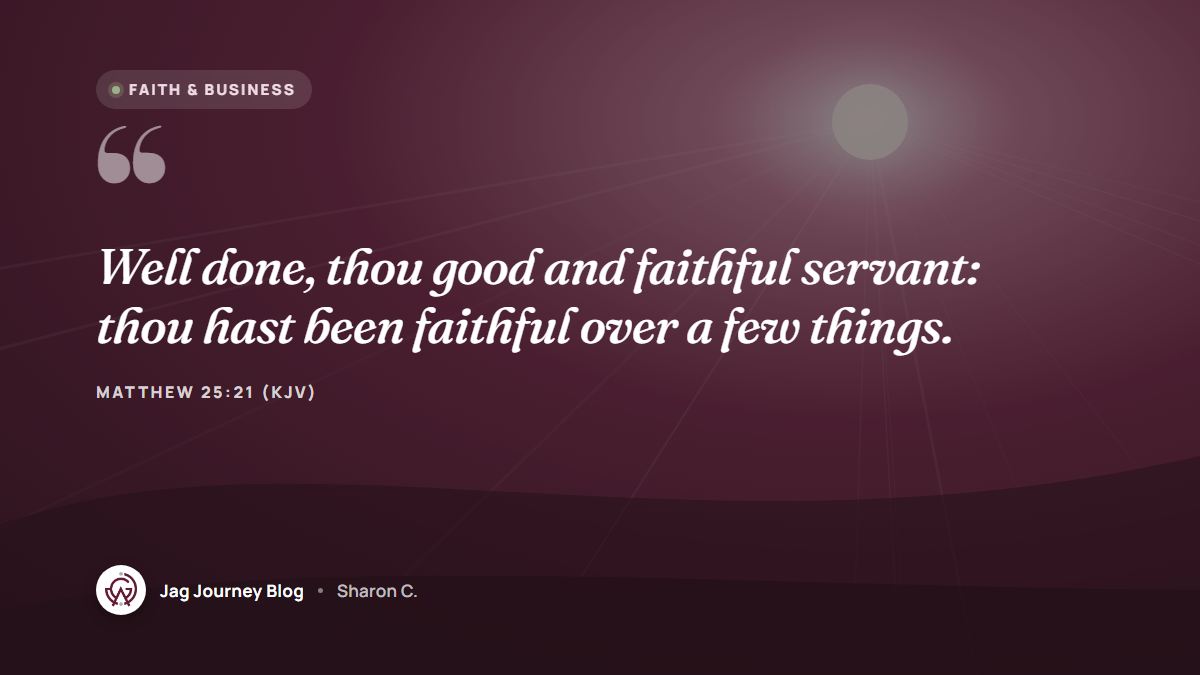
The first two servants put the money to work and double it. The third digs a hole and buries his talent. When the master returns, he praises the first two in identical words: "Well done, thou good and faithful servant: thou hast been faithful over a few things, I will make thee ruler over many things: enter thou into the joy of thy lord." (Matthew 25:21, KJV).
The third servant explains himself: he knew the master was demanding, so he was afraid, and he hid the money. The master rebukes him, and the talent is taken away.
It is worth saying plainly that this parable sits in a series of teachings about the kingdom of heaven and readiness for Christ's return. Its first meaning is about how we live as people entrusted with God's gifts while we wait for him. Applying it to business is a secondary application. It is a fair one, because a business is one of the places where we steward what God has given.
Lesson 1: Different amounts, the same standard
The servants did not receive the same amount. That was not unfair. It reflected their abilities. And the master's praise for the servant with two talents was word for word the same as his praise for the servant with five.
For business owners, this is freeing. You may run a one-person shop while someone at your church runs a company with hundreds of employees. The standard is not the size of what you were given. It is faithfulness with it.
Lesson 2: Fear makes us bury things
The third servant's problem was not a lack of ability. It was fear. He saw the master as harsh, so he played it safe in a way that produced nothing.
Business owners bury talents out of fear all the time. A skill goes unused because you worry you are not good enough. A product idea stays in a notebook because it might fail. A needed conversation with a customer or employee is avoided. Fear often looks like prudence from the inside.
Lesson 3: Faithfulness involves action and some risk
The faithful servants "traded" with the money. They took action, and any trade involves some risk. Faithful stewardship is not the same as never risking anything.
That does not mean reckless gambling. Scripture elsewhere warns against haste and urges counting the cost. Wise risk is considered, limited and taken with counsel. Buried safety, the parable suggests, is its own kind of risk.
Lesson 4: The reward is joy and responsibility
Notice what the master gives the faithful servants: more responsibility and an invitation into his joy. The parable does not promise that faithful people will always see financial growth. It shows that faithfulness is noticed and that it leads to deeper trust and shared joy with the Master.
Your business may grow or it may not, for many reasons outside your control. The invitation to faithfulness remains either way.
An inventory exercise: what have you been given?
Set aside thirty minutes. Make a list under each heading below. Be specific.
- Skills. What can you do well? Include skills you rarely use at work.
- Knowledge. What do you understand that your customers or community do not?
- Relationships. Who do you know, and who trusts you?
- Assets. Equipment, space, savings, inventory, digital assets such as a website or email list.
- Time. Where does your time go each week, and where is there unused capacity?
- Reputation. What are you known for?
Now look over your list and ask three questions:
- Which of these am I using faithfully right now? Thank God for them.
- Which one have I buried, and why? Be honest about whether fear is involved.
- What is one small, reasonable step to put that buried talent to work in the next month?
Write your answer to the third question as a single action with a date. "Teach one workshop on bookkeeping basics for local makers by the end of next month" is better than "use my accounting skills more."
Taking wise risk without recklessness
When you act on that step, a few guardrails help:
- Set a limit on how much money and time you will invest before you review results.
- Ask counsel from someone who will be honest with you. Our post on praying through a business decision offers a fuller process.
- Protect your obligations. Do not risk money owed to employees, vendors or tax authorities.
- Review and adjust. Faithfulness includes learning from what happens.
If you want to read the parable slowly in more than one translation, JustAllowGod offers free tools to compare versions side by side and look up the original Greek words. Reading the surrounding chapters, Matthew 24 and 25, will help you see the parable in its full setting.
For a broader look at managing everything as entrusted, see owner or steward.
Frequently asked questions
Does the parable of the talents mean God wants me to be rich?
No. The parable is mainly about faithfulness with what God entrusts to us while we wait for his return. It praises faithful action, not wealth itself, and other passages warn strongly against loving money.
What if I take a risk and it fails?
Faithful action does not guarantee success. If you acted wisely, with counsel and within reasonable limits, a failed attempt is still faithfulness. Learn from it, care for anyone affected and keep going.
How do I know if I am being cautious or just afraid?
Ask whether your caution is based on clear facts and counsel or on a vague dread of failure or judgment. If you cannot name a specific risk but still feel stuck, fear may be in the driver's seat.
Related Posts

The Gleaning Principle: Leaving Room for Others in Your Business Model
God told farmers to leave the edges of their fields for the poor. Here is how that gleaning principle can shape a business model through sliding scales, reserved seats and dignified access.

Building a Business With Legacy in Mind
A business legacy is more than money left behind. Here is how to think about the people you develop, the reputation you build and the practical plans that let your work outlast you.

Building Cash Reserves for Lean Years: Lessons From Joseph
Joseph stored grain during seven good years so Egypt could survive seven lean ones. Here is how a small business can build a cash reserve, protect it and still avoid hoarding.
Bezalel and the Sacred Value of Skilled, Creative Work
The first person Scripture describes as filled with the Spirit of God was a craftsman. Bezalel's story offers encouragement and practical wisdom for artisans, makers, designers and creative business owners.

Thinking Biblically About Business Debt
Scripture does not forbid all borrowing, but it treats debt seriously. Here is a balanced look at what the Bible says and seven questions to ask before your business takes on a loan.
Comments (0)
No comments yet. Be the first to share your thoughts!