Designing AI Features That Refuse to Invent Facts

Language models have a well-known weakness: they produce fluent, confident text whether or not it is true. Ask a model about a product feature that does not exist and it may describe how to use it. Ask for a statistic and it may supply a plausible number. In casual conversation that is an annoyance. Inside a product, where people act on what they read, it can cause real harm.
We design the AI features in our platform around a principle: the AI should work from approved sources, say where its answers came from and hand off to a person when it cannot answer reliably. Here is how that principle shows up in practice.
Prefer selecting over composing
The safest AI answer is often not a new paragraph at all. In our in-app help, the AI's job is to select the most relevant reviewed article and show its approved text with a citation, rather than writing instructions in its own words. Customers read instructions a person wrote and checked. You can read more in help answers grounded in reviewed articles.
Selecting is less impressive than composing, and it is far more trustworthy.
Give the model the facts it needs
When an AI feature must write, such as drafting a website for an organization, we give it the organization's own information: what it does, who it serves, how it describes itself. The model's job is to arrange and phrase those facts well, not to supply new ones. Instructions tell it explicitly not to invent customer counts, testimonials, awards, prices or credentials.
The same rule applied to this blog. The writers who drafted these articles worked from a written fact sheet for each Jag Journey product, and anything not in that sheet stayed out.
Make "I do not know" an acceptable answer
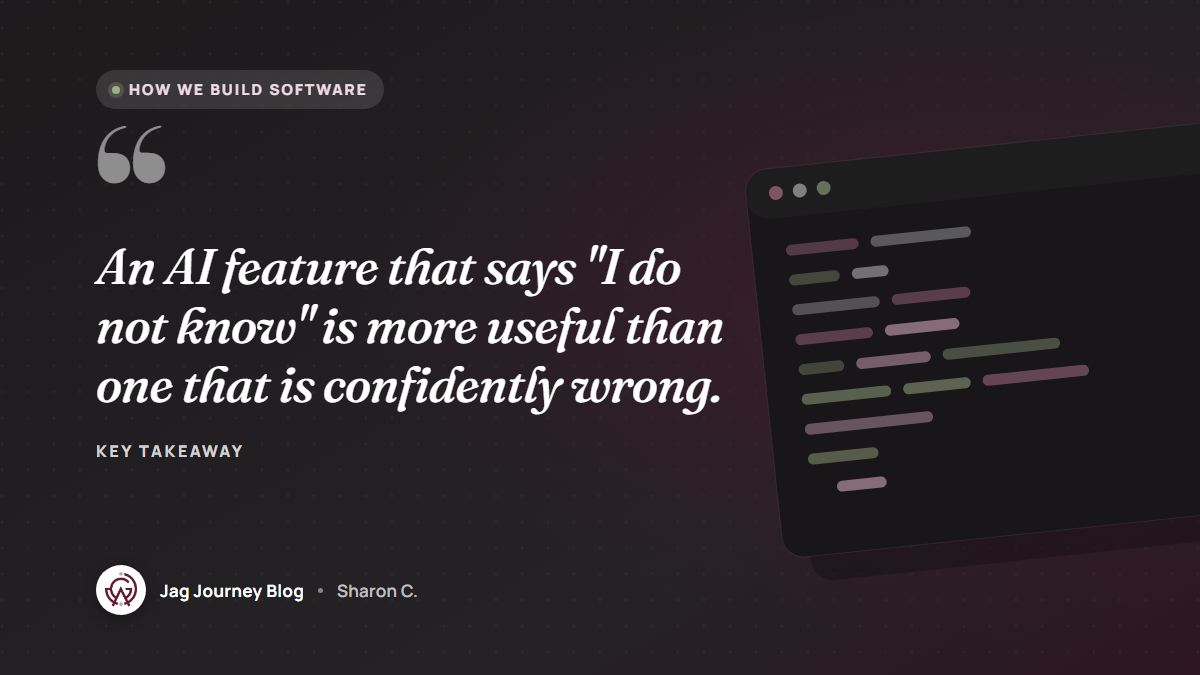
Many AI features are designed so the model always produces something. We design ours so that "no good answer" is a legitimate outcome with a good path forward. When the help assistant cannot find a relevant article, it says so, points to the Help Center and offers to open a support ticket. When a question touches something sensitive, like billing or account security, it hands off rather than guessing.
A feature that admits its limits keeps people's trust. A feature that bluffs loses it the first time it is caught.
Keep sensitive decisions with people
Some decisions should never be made by an AI alone, however capable it seems. In our platform, AI features can suggest, draft and summarize, but they do not send customer replies without a person choosing to send them, publish content without a person choosing to publish or move money at all. For example, when our support team uses AI to draft a reply to a ticket, the draft stays private until the team member reviews it and chooses to send it as their own.
Check outputs with rules, not only with eyes
People reviewing AI output get tired, especially when there is a lot of it. So we add automatic checks where we can. For content, that includes rules that flag filler phrases, contact details that should not appear, formatting problems and links that do not point to real pages. Rules do not replace review, but they catch the predictable mistakes so reviewers can focus on judgment.
Moderation is a signal, not a verdict
AI is also useful for spotting problems, such as harmful content in a community forum. Even there, we treat the AI's assessment as a signal for a person to review rather than a final judgment, except in narrow, clearly defined cases. We explain that balance in using AI moderation as a signal.
Honest about how content was made
When AI helped produce something, we do not pretend otherwise. Our policies on AI drafting are written down, and our own content follows the same rules we recommend to customers. That honesty is part of why people can trust what they read on our sites.
What this means for customers
Organizations using our AI features get help that is fast without being reckless. Their visitors read pages that say what is true about the organization. Their members get help answers that match how the product actually works. And when the AI reaches the edge of what it knows, a person steps in. That is the kind of AI we want to put our name on.
Frequently asked questions
What is an AI hallucination?
It is when an AI model produces confident but false information, such as describing a feature that does not exist or inventing a statistic.
How do you stop AI from making things up?
We give AI features approved sources to work from, prefer selecting reviewed content over writing new instructions, allow "no answer" as an outcome and keep people in charge of sensitive decisions.
Does Jag Journey use AI to answer support tickets automatically?
AI can draft a reply privately for a team member, who reviews it and chooses whether to send it. Automatic replies are limited to reviewed help content with a citation.
Related Posts
Keeping AI Model Choices Current
AI models change every few months, and yesterday's best choice can quietly become outdated. Here is how we keep model choices current without breaking features.

Consent First: How We Handle Email and Text Message Permissions
Sending messages people did not ask for damages trust and breaks rules. Here is how our platform treats consent, unsubscribes and suppression as features, not fine print.
AI Drafts Are Not Finished Work
AI can produce a full website draft or article in minutes. Here is why we treat every AI result as a draft until a person reviews it and chooses to publish.

Using AI Moderation as a Signal, Not a Judge
AI can spot harmful content quickly, but it also makes mistakes. Here is how we use moderation results to alert people, and where narrow automatic action is justified.
Every Payment Lands in the Books
A payment that never reaches the accounting records creates work and risk later. Here is how our payment flows connect to the books from the very first charge.
Comments (0)
No comments yet. Be the first to share your thoughts!